
BMF-Info alleviates the land acquisition tax through EU Court of Justice ruling
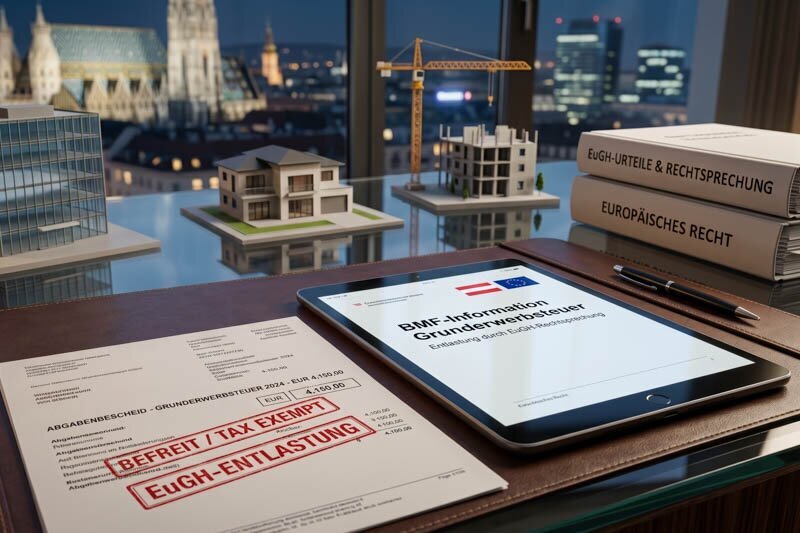
Impact of the EU Court of Justice judgment „Nova Iberomoldes“ on Austria
In its judgment in the „Nova Iberomoldes“ case (C-837/24), the Court of Justice ruled in early June 2026 that the collection of the Portuguese land acquisition tax on certain share transfers to land ownership companies is not compatible with the Capital Gains Directive (Regulation 2008/7/EC) and is therefore unlawful under EU law. The BMF has responded to this Court of Justice decision, which has significant implications for the Austrian land acquisition tax due to similar legal circumstances, and published an information document at the end of July.
Objective of the capital accumulation directive and eligible restructuring
The Capital Gains Directive aims to ensure that capital inflows and restructuring within the EU are largely exempt from indirect taxes (such as the property acquisition tax), thereby guaranteeing the freedom of capital movement. In Austria, according to the BMF Info, AGs, GmbHs and SEs are, in principle, considered capital companies under the Capital Gains Directive. Certain acquisition transactions under § 1 (3) GrEStG are considered eligible restructuring under the Capital Gains Directive – in particular when, as part of a contribution, split, merger or similar structural measure, shares in a land-owning company are transferred to another capital company and company rights are granted in exchange in the acquiring company.
Beneficiary transactions according to BMF information
Specifically, according to BMF-Info, this includes:
- simple contribution of a share of capital to a land-owning company outside the UmgrStG;
- (Downstream and Sidestream) contribution of a share of capital to a land-owning company or a (part-)operation with a share of capital in a land-owning company;
- (Downstream and Sidestream) splitting of a share of capital in a land-owning company or a (partially) operating business with a share of capital in a land-owning company;
- (Sidestream) merger, in which a share of capital is held in the assets of the transferring company in a company owning the property;
- Corresponding „diagonal“ transactions (e.g., the contribution/division of a share of capital in a real estate-owning company within a group between different stakeholders at different levels, such as between cousins’ companies).
Achieving the majority of voting rights and the non-observance of the share allocation
The BMF assumes that, in normal circumstances, when the shareholding association statute is implemented, the majority of voting rights will be transferred or achieved, meaning that these cases fall under the capital accumulation directive. It makes no difference whether new shares are granted, the remuneration is paid with the existing shares of the previous shareholders, or the share buyback tax law is applied (or not).
Immediate application of EU law and elimination of the tax obligation
The BMF Info emphasizes that the present EU Court of Justice ruling and the Capital Aggregation Directive are directly applicable due to the primacy of European law. If the above circumstances are present (according to the jurisprudence of the EU Court of Justice, these are restructuring pursuant to the Capital Aggregation Directive), the tax authorities must assume that there is no GrESt requirement in Austria. Consequently, if the above requirements are clearly met, self-calculation of the GrESt or declaration of tax may be omitted.
Open legal questions and possibility of correction under § 299 BAO
However, according to BMF-Info, the legal situation is not yet sufficiently clear for other transactions or other corporate forms, which is why GrESt must still be paid. Furthermore, the possibilities for initiating proceedings must be taken into account (here, the annual period set out in § 299 of the BAO must be taken into account), which may even allow the already paid acquisition tax to be recovered in some cases that have already arisen before the European Court of Justice.
Image: Illustrative representation (generated by AI)
© ebit Steuerberatung GmbH | Client Information