
Carbon pricing and regional climate bonus as components of the ecological and social tax reform
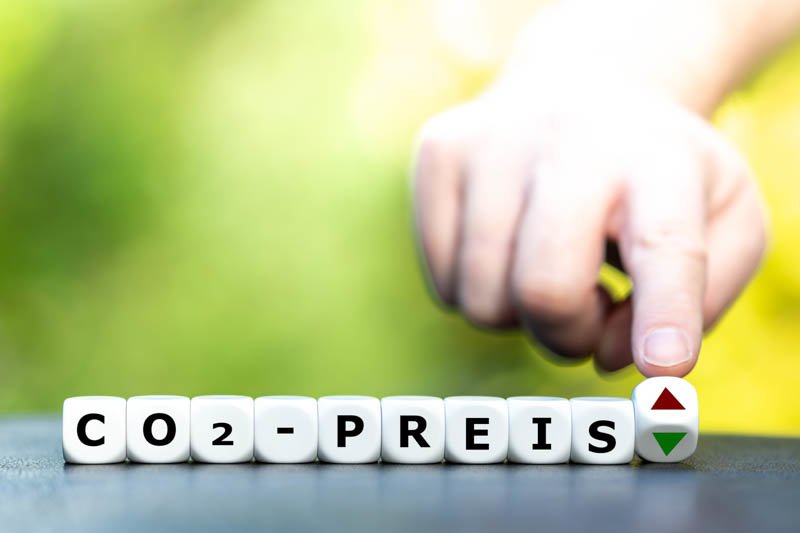
The ecological tax reform includes, as a measure to promote ecological development, primarily the introduction of a CO2-Punishment. In principle, mineral oil companies or gas suppliers ("distributors") must pay CO2-They acquire certificates and then pass on the associated financial burden to the consumers. It is not intended that the actual use of the fuels by the consumer matters.
As a first step, a national emissions trading system is to be established, which can subsequently be converted into a European emissions trading system. Starting in July 2022, the national emissions trading system (it is divided into an introduction and a transitional phase) will be in operation with pre-set prices per tonne of CO2 operate. This is intended to also take into account sectors outside the EU emissions trading system (buildings, transport and parts of industry). The CO2-The price per tonne is expected to be €30 in 2022, €35/t in 2023, €45/t in 2024 and finally €55/t in 2025. Taking into account the already existing taxation of fossil energy sources in Austria (e.g. mineral oil tax, natural gas tax), which is implicit in the CO2-The price can be converted, the new CO states2-Payment of a (increased) total charge.
From January 2026, it is planned that the emissions trading system will transition into a market phase – for administrative reasons, the emissions trading system is intended to tie into existing energy levies and be phased out together with them. Likewise, relief measures are planned to address cross-border competitiveness, avoid carbon leakage, and mitigate specific additional burdens. In this context, carbon leakage refers to unjustified competitive advantages whereby greenhouse gas emissions are shifted abroad to reduce production costs. Finally, a hardship scheme is intended to help particularly hard-hit companies.
As a counterpoint to the strain caused by the CO2-The evaluation draft also includes the "regional climate bonus". This is intended to increase the revenue from the CO2-Compensation is paid back to the population. The amount of the climate bonus depends on the classification of the residential community; in urban centers with the highest level of development through public transport, a climate bonus of €100 per year is provided. Residents of urban centers with at least good public transport access are to receive a climate bonus of €133. Other categories include centers and the surrounding area with at least (good) basic access (bonus of €167), and finally rural municipalities and municipalities with only basic access (bonus of €200). The climate bonus is to be paid in full as early as 2022 – for children there is an additional surcharge of 50 %%. All persons residing or habitually residing in Austria will benefit from the climate bonus.
Image: © Adobe Stock - Focused
© ebit Steuerberatung GmbH | Client Information