
Tax Reform Act 2024 - Significant changes on the horizon
At the beginning of May, the Tax Reform Act 2024 was published for review. Selected key aspects are outlined below. We will keep you informed about the further legislative process.
Tax-free food donations
The donation of food to charitable organizations eligible for benefits is expected to be tax-neutral as of January 1, 2024. Technically speaking, the tax book value (which corresponds to the total cost of the donation) can be deducted as operating expenses, instead of having to determine a fair value. From January 1, 2025, changes will take place in terms of VAT; a real (VAT) tax exemption is planned for food donations to these organizations. Consequently, the (proportional) right to the pre-tax deduction will not be lost either.
Tightening and easing of group taxation
Previously, under group taxation, the non-deductibility of partial depreciation and disposal losses within the corporate group was provided for under certain conditions. Now, another restriction is intended to be introduced: losses that are eligible for deduction by the corporate group from periods before the corporate group came into effect shall not be deducted, insofar as they include (previously deductible) depreciation on the lower partial value and disposal losses in respect of interests in bodies that were already members of another corporate group at the time of the depreciation or disposal loss (the same shall also apply to seven-tenths of the share capital that has not yet been taken into account). This is intended to prevent a double loss reversal, particularly in the case of corporate group expansions.
Furthermore, from the taxation year 2024 onwards, it should be possible to waive the inclusion of losses of a foreign group member.
Finally, within the framework of group taxation, an easing of the requirement to file a group tax return is provided for. In connection with the strict interpretation by the BFG (see the article from August 2023Now it is possible to submit the group application via FinanzOnline using electronic signature.
Introduction of a EU-wide small business regulation starting in 2025
The draft of the 2024 tax law introduces significant changes to the small business regime – the starting point is the fact that until now, sales in another member state were not covered by the small business exemption, which could result in administrative costs and disadvantages for small businesses.
Now, as part of the implementation of EU regulations, a "EU small business" has been created so that Austrian companies can also benefit from the small business exemption in other Member States. Conversely, foreign companies in Austria are also expected to be able to use the small business scheme. Due to this change, the § 6, paragraph 1, item 27 of the UStG is also to be adapted in the course of the AbgÄG 2024.
The essential prerequisite for claiming the EU Small Business Scheme is that the small business’s turnover in the EU does not exceed €100,000 in the previous year and in the current year (the calendar year is decisive in each case) (so-called Union-wide threshold, which is based on the annual Union-wide turnover). Furthermore, the respective local thresholds must not be exceeded, with Member States being able to implement a tolerance limit for the one-time exceeding of the local thresholds.
For example, if foreign companies in Austria wish to claim the small business scheme, the EU-wide turnover must not exceed the threshold of €100,000 (in the previous year and the current year). In addition, the local threshold value must be observed. The Austrian local threshold value is to be €42,000 and in the future to be a gross limit. Until now, the €35,000 was understood to be the net limit, which practically meant that for the application of the small business exemption, a limit of €42,000 also had to be set for sales at the normal tax rate. If the local threshold is exceeded, but by no more than % 10%, the small business tax exemption can still be claimed until the end of the calendar year. The exemption is to be deducted from the sales that exceed the 10 % tolerance rule. For this and all subsequent sales, the exemption should therefore no longer be possible. Until now, the tolerance rule for small businesses in Austria was structured in such a way that a one-time exceeding of the sales threshold by no more than 15 % within five calendar years was negligible. However, following the old tolerance rule, exceeding the revenue threshold had an impact on the start of the year.
Administratively speaking, the application for the EU Small Business Rule must be submitted in the state of residence, that is, in the country where the company is operating (for Austrian small business owners who also want to benefit from the Small Business Rule in other Member States, the application must be submitted in Austria). If the application is successful, a Small Business Identification Number with the suffix "-EX" shall be issued. The Small Business exemption shall be applicable from the notification of this identification number.
From the time of registration, there shall be an obligation to submit quarterly reports on sales (submitted by the end of the month following the calendar quarter). These reports must be submitted by the taxpayer who claims the cross-border small business regime in the state of residence, with the EX-ID number provided. Any exceeding of the Union-wide threshold must be reported within 15 working days. Sales that have already occurred must still be reported.
Finally, small businesses will in the future be able, regardless of the invoice amount, to issue simplified invoices in accordance with Section 11, Paragraph 6 of the Value Added Tax Act. However, if the small business exemption no longer applies, the simplified invoice issuance shall only be permitted for invoices whose total amount (as before) does not exceed €400.
Clarification regarding the performance location for streaming services
So far, there have repeatedly been difficulties in determining the (taxation-related) place of performance when services were provided virtually, as is the case with streaming services. The place of performance regulation is therefore to be expanded as of 1 January 2025 in such a way that it will in future also cover streaming services that do not fall under § 3a(11)(a) UStG (e.g., interactive online language courses). In line with the place of performance regulation for electronically supplied services, the place of performance for these services should also be the place where the recipient has their domicile or habitual residence.
Conversion of "Phantom shares" into equity for start-up employees
By the end of 2025, the possibility should be created to convert the remuneration (in the form of virtual shares) previously provided in the form of Phantom Shares into start-up employee participation, without requiring any evaluation or taxation of the monetary benefit resulting from the subsequent redemption of the virtual company shares. However, this is only possible if all the requirements for a start-up employee participation (See the article from July 2023 for more information.) are met.
Planned changes under the BAO and the Fees Act
Changes to the BAO are intended to limit requests for extensions to the filing deadline for tax returns to a single extension of at least one week. Similarly, there will be restrictions on sales tax credit interest rates.
To avoid a double fee burden, an exemption under the Fees Act is provided for those attachments that are submitted electronically to the authority and have already been submitted in paper form in the same proceedings (and accordingly granted).
Wage tax changes
Starting with the tax assessment notice for the calendar year 2024, tax assessment notices (in accordance with § 63 of the EStG) will only be issued upon request.
The possibility of making a tax return without filing a tax return should be expanded in the future. It is planned that this option should also be available in the event of a mandatory tax return, provided that all requirements for making a tax return without filing a tax return are met (for the first time starting with the tax return for the 2024 calendar year).
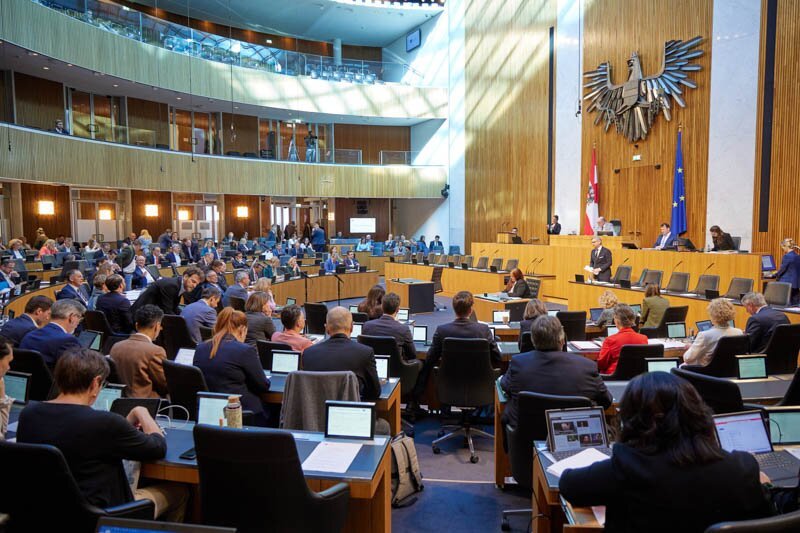
Photo: © Parliament Directorate/Thomas Topf
© ebit Steuerberatung GmbH | Client Information